Key takeaways
- China’s economic growth has slowed, facing trade tensions and a persistent property crisis.
- U.S.-China tariffs and export restrictions are reshaping global trade and manufacturing dynamics.
- Diversifying with emerging market stocks, including China, can help manage portfolio risk.
China remains a dominant force in the global economy, but its economy faces significant headwinds. The country’s real gross domestic product (GDP) growth, a common economic activity measure, once in double digits during the 2000s, slowed to 4.8% (year-over year) in 2025’s third quarter.1 China continues to serve as a major global trading partner, the size of its economy ranking second in the world only to the United States.2
administration reframed U.S.-China trade relations by imposing escalating on Chinese imports. After several rounds of negotiations, the two countries reached a one-year trade agreement on November 1, stabilizing trade relations into 2026. The U.S. reduced certain tariffs, while China resumed regular purchases of U.S. soybeans and paused rare earth export controls.
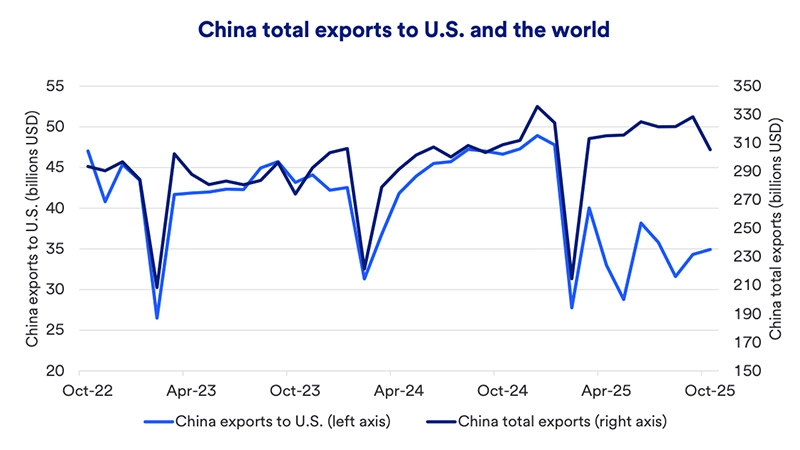
China’s freight activity to the U.S. has slowed
China modernized its economy in the 1980s, quickly emerging as a global economic power by leveraging a skilled labor pool, infrastructure investments, and low-cost production. Exports fueled China’s economic rise, leading to rapid middle-class growth. Entering 2025, the U.S. was the largest customer for Chinese goods.3
Today, the Trump administration’s push to reduce Chinese imports could negatively impact China’s economy. “China hopes it can replace by stepping up exports to other countries,” says Rob Haworth, senior investment strategy director with U.S. Bank Asset Management Group. IN 2025, China increased total exports, with gains in Asia, Africa, Europe and Latin America offsetting slower exports to the U.S.4
China’s government actively pursues policies to boost manufacturing activity, including incentivizing to replace durable goods like washing machines. China also competes technologically in global markets. Notably, China-based electric car maker BYD surpassed Tesla in total electric vehicle sales at the end of 2024.5
China’s property overhang
China’s property crisis, which began in 2021, continues to challenge China’s economy. Overdevelopment and easy credit led to oversupply and falling prices, pressuring construction. Previously, surging property development fueled China’s rapid growth, accounting for nearly one-third of GDP.6
Although retail sales improved in early 2025, it’s unclear this trend will last. “Stimulus measures are boosting consumer spending, but savings are also rising,” says Haworth. “Even though the economy isn’t accelerating, it is still growing.” Other data, such as low consumer and declining government bond yields, signal sluggish activity and subdued growth expectations. Additionally, China routinely suppresses unfavorable , such as youth unemployment, indicating other areas of struggle.
Investment challenges and opportunities persist.
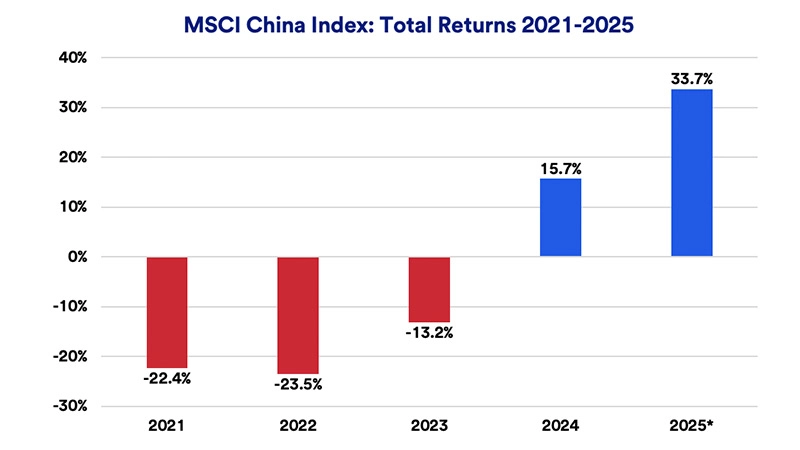
China’s equity markets struggled through most of the 2020s. After a three-year losing streak from 2021 to 2023, stocks rallied in 2024 based on the MSCI China Index’s performance. A weakening fueled additional gains in 2025 by increasing China equity market returns for U.S.-based investors. By October 10, 2025, however, the MSCI China Index remains 30% below its February 2021 peak.
“Any investor who puts money to work in a broad, emerging market index owns a significant position in Chinese stocks.”
–
Rob Haworth, senior investment strategy director for U.S. Bank Asset Management Group
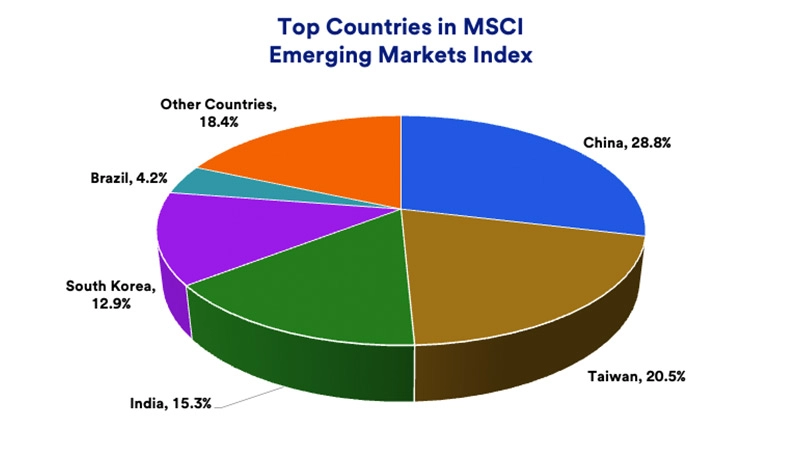
Despite its size, investors still classify China as an emerging market. China holds the largest single-country weight in the MSCI Emerging Markets Index, representing nearly 30%.8 “Any investor who puts money to work in a broad, emerging market index owns a significant position in Chinese stocks,” says Haworth.
In 2024, the MSCI Emerging Markets Index generated a 7.5% total return, outpacing the MSCI EAFE developed markets index, but significantly underperforming U.S. markets. By comparison, the S&P 500 earned a 25.0% total return last year. In 2025, global market performance improved, with the MSCI Emerging Markets Index rising 29.0% through November 19, compared to the S&P 500’s 14.2% total return.9
Investing in international stocks
I Investing in international stocks strengthens portfolio diversification. “Global stocks offer an attractive investment opportunity to manage risk from elevated U.S. equity values and trade uncertainty,” says Haworth.
Haworth recommends a broad emerging market allocation, including some Chinese stocks, to diversify your portfolio with exposure to China’s market. Emerging market indices also offer broader sector diversification than U.S. counterparts. “Today, compared to the past, we find more manufacturing and exporters across emerging market economies,” says Haworth. “Many of these manufacturers outside of China may benefit from U.S.-China trade fallout.”
Align any changes to your investment strategy with your goals, time horizon and risk appetite. Consult your U.S. Bank to review your financial plan and determine if emerging market stocks, including China, fit into your portfolio.
Note: The MSCI China Index captures large and mid cap representation across China A shares, H shares, B shares, Red chips, P chips and foreign listings (e.g. ADRs). With 568 constituents, the index covers about 85% of this China equity universe. Currently, the index includes Large Cap A and Mid Cap A shares represented at 20% of their free float adjusted market capitalization. The MSCI Emerging Markets Index captures large and mid-cap equity performance across twenty-four emerging market countries. Investing in emerging markets may involve greater risks than investing in more developed countries. In addition, concentration of investments in a single region may result in greater volatility. International investing involves special risks, including foreign taxation, currency risks, risks associated with possible differences in financial standards and other risks associated with future political and economic developments.