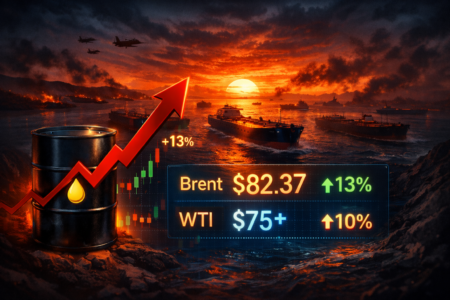
Oil prices continue to climb rapidly after the latest conflicts in the Middle East. In particular, U.S. and Israeli air strikes targeting Iran shook the markets. As a result, major concerns have emerged over global energy supply. Notably, international benchmark Brent crude recorded strong gains.
Why Are Oil Prices Rising?
The strategically vital Strait of Hormuz sits at the center of this tension. In addition, the possibility that Iran could close this critical passage is alarming the markets. Therefore, any disruption to global tanker traffic pushes prices directly higher.
Similarly, Qatar’s decision to suspend LNG production after regional attacks has deepened the crisis. Meanwhile, Western countries are taking various steps to protect supply security. However, geopolitical risks continue to place strong pressure on oil prices. Consequently, global markets are trying to find direction in this unprecedented environment of uncertainty.
Effects on the Global Economy and Future Expectations
Rising costs are also seriously threatening global inflation targets. The transportation and logistics sectors, in particular, became among the first to feel the shock. At the same time, airline stocks are seeing notable declines. For this reason, central banks’ interest-rate cut plans will most likely face setbacks.
Investors are quickly shifting toward safe-haven assets such as gold. As oil prices rise, we observe a broad contraction in global risk appetite. In addition, potential production decisions by OPEC+ countries will determine the market’s main direction. As a result, sharp volatility in the energy sector is set to continue for some time.
A Critical Period for Investors
Market dynamics clearly indicate that supply-side risks could last for an extended period. Therefore, the upward momentum in oil prices will likely remain strong. Continuous demand growth in Asian markets further supports this trend. At the same time, forced changes in logistics routes are multiplying freight costs.
Expert institutions continue to warn against a tightening in energy supply. For that reason, investors need to monitor energy supply chains closely throughout this period. Moreover, high volatility in the sector may become a permanent structure. Ultimately, global energy policies will be shaped by these new security crises.
In this context, developments in oil prices will remain in focus for all investors. Even movements in energy stocks are directly steering major stock-market indices. In the end, crossing such critical thresholds in the markets can lead to lasting changes in the global economy.
For more updates on commodity markets, energy prices, and global economic developments, explore our latest market coverage.